

When people talk about a traction battery for a forklift, stacker, or warehouse equipment, we are not talking about a “large starter battery”. A Traction PzS battery is a serviceable flooded lead-acid battery designed for deep cycles, long discharges, vibration, elevated electrolyte temperature, and regular recovery after operation.
PzS Traction Battery vs. Starter Battery: What’s the Difference?
| Aspect | Starter battery | PzS traction |
| Load profile | short burst | hours of work |
| Main check | cranking current | C₅ capacity |
| Design logic | start engine | deep cycle |
Why the Tubular Plate Matters
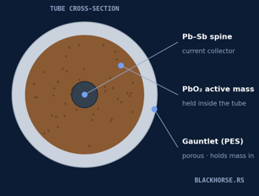
A classic PzS cell is a 2-volt flooded lead-acid cell with tubular positive plates. In the positive plate, the active material PbO₂ is retained inside tubes, while current is collected by lead-antimony spines. This design mechanically supports the active material, reduces shedding, and tolerates deep cycles better than a conventional flat positive pasted plate.
Anatomy of a Tubular Positive Plate
Pb–Sb spine — current collector at the center
PbO₂ active mass — held inside the tube
Gauntlets — holds the mass
What Is C₅ Capacity in a PzS Traction Battery?
PzS batteries are evaluated not by cranking current, as starter batteries are, but by stable C₅ capacity, cycle life, and the ability to recover after deep discharge. The rated capacity of traction batteries is specified in the 5-hour discharge mode: I₅ = C₅ / 5 h. In the standardized test, the lower cut-off voltage for a cell is 1.70 V/cell at 30 °C.
I₅ = C₅ / 5 h
Why Are PzS Traction Batteries Rated at the C₅ Discharge Rate?
The capacity a lead-acid battery actually delivers depends on how fast it is discharged: the higher the current, the fewer ampere-hours (Ah) you get out. This is described by Peukert’s law, which in simplified form links discharge current and discharge time:
Ik × t = constant
where k is the Peukert exponent — about 1.1–1.3 for lead-acid (≈1.25 is a common average). Because faster discharge means less usable capacity, a traction battery’s rating is fixed at a defined, moderate rate — the 5-hour C₅ mode — so the figure stays comparable and realistic for warehouse duty.
What Happens Inside a PzS Traction Battery During Discharge?
During discharge, it is not “only the acid” or “only the plates” that work. The negative plate changes from sponge lead Pb into PbSO₄. The positive plate changes from PbO₂ into PbSO₄. Sulfuric acid is consumed and water is formed, so electrolyte density decreases.
Overall discharge reaction:
Pb + PbO₂ + 2H₂SO₄ → 2PbSO₄ + 2H₂O
Why Manufacturing Quality Determines PzS Battery Service Life
During charge, the reaction proceeds in the opposite direction. That is why the service life of a PzS battery is not created by one “secret” process. It is the result of repeatability across the whole production chain:
oxide → paste → grids → curing → assembly → formation
That is why a traction battery is not just a container, lead, and acid. It is a controlled electrochemical system where plate design, paste quality, formation parameters, and control at each production stage directly affect service life.
Electrochemical Reactions During Battery Discharge
| Stage / zone | Reaction or transformation | Technological meaning |
| Discharge, negative plate | Pb + SO₄²⁻ → PbSO₄ + 2e⁻ | Sponge lead turns into lead sulfate. If the negative mass is too dense or poorly wetted, part of the Pb does not contribute during the C₅ test. |
| Discharge, positive plate | PbO₂ + SO₄²⁻ + 4H⁺ + 2e⁻ → PbSO₄ + 2H₂O | PbO₂ consumes acid and converts to PbSO₄. This is why electrolyte density falls during discharge. |
| Overall on discharge | Pb + PbO₂ + 2H₂SO₄ → 2PbSO₄ + 2H₂O | This is the basic lead-acid chemistry. On charge the reaction runs in the reverse direction. |
Key Takeaways: What Makes a PzS Traction Battery Different?
- A PzS battery is a deep-cycle traction system, not a scaled-up starter battery.
- It is judged by C₅ capacity, cycle life, and recovery after deep discharge — not by cranking current; the standard cut-off is 1.70 V/cell at 30 °C.
- Tubular positive plates hold the PbO₂ active mass inside tubes, cutting shedding and surviving repeated deep cycles.