
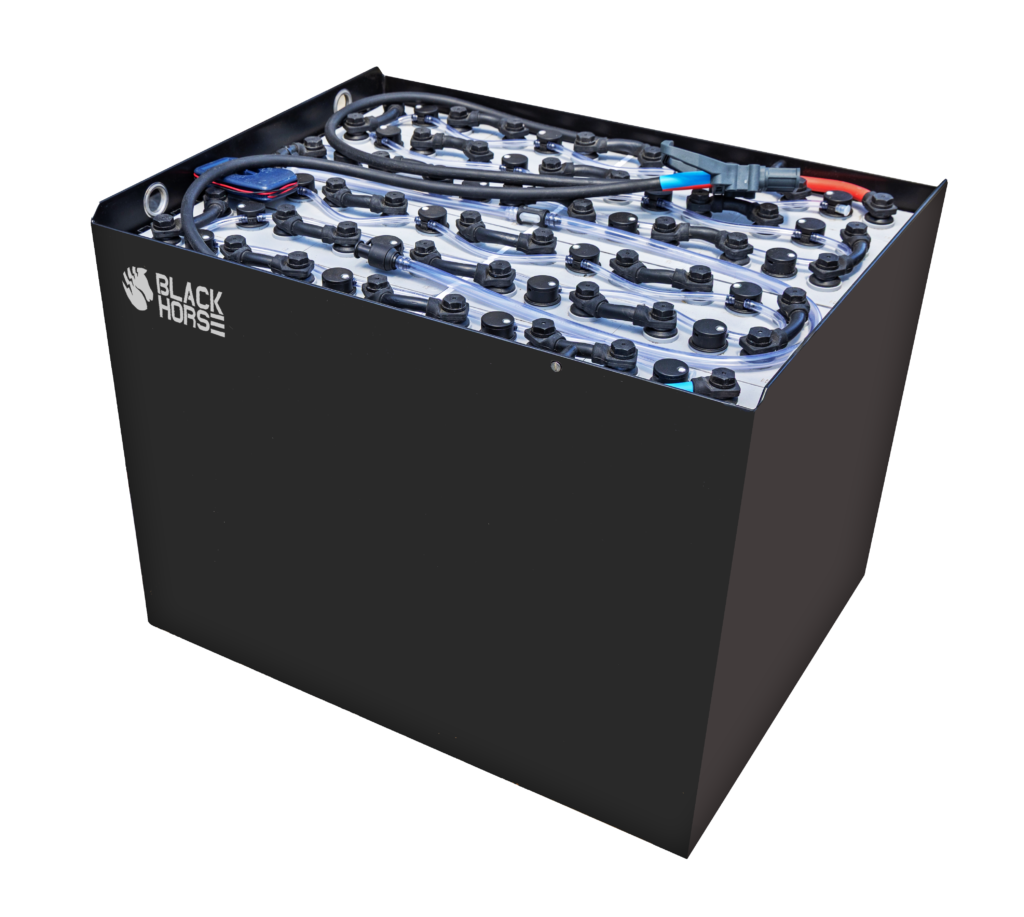
In previous posts, we looked at how a traction battery is made: oxide, paste, grids, curing and formation. But the service life built into the battery during production is only its potential. How much of that potential is realized is determined during operation. Today, we look at what ages a PzS battery and which conditions help it achieve its designed service life.
Electrolyte — the Built-In State Indicator
In a lead-acid system, the electrolyte does more than conduct current: sulfuric acid participates directly in the reaction together with the lead dioxide of the positive plate and the sponge lead of the negative plate. During discharge, sulfuric acid is consumed and water is formed:
Pb + PbO₂ + 2H₂SO₄ → 2PbSO₄ + 2H₂O
Therefore, electrolyte density decreases during discharge and is restored during charge.
The state of charge of a PzS cell can be estimated approximately from the electrolyte density. For a fully charged and mixed cell, it is one of the most useful indicators of state of charge. Typical values for a traction PzS battery:
- fully charged cell: 1.28–1.30 g/cm³
- density below 1.14 g/cm³ — deep discharge
- charging is complete when density and voltage remain stable for two hours.
Density measurements should be taken only after a full charge, at the nominal electrolyte level and after mixing; readings should be corrected to a reference temperature of 30 °C:
ρ₃₀ = ρₜ + 0.0007 × (T − 30)
A measured density of 1.280 g/cm³ at 45 °C corresponds to 1.290 g/cm³ at 30 °C.
Open-circuit voltage also increases with density: in a fully charged cell, it is 2.12–2.15 V. Under load, however, voltage depends on current, while density is affected by temperature and stratification. Therefore, state of charge is more accurately assessed using a combination of density, voltage and temperature.
Sulfation
Lead sulfate is formed during every discharge. During charging, small PbSO₄ crystals dissolve and are converted back into PbO₂ and sponge lead. Problems begin when a battery remains discharged for a long time: the small crystals recrystallize into large, dense ones. Large sulfate crystals barely dissolve during normal charging—part of the active material remains in the plate but is no longer electrochemically active, and the available capacity gradually decreases.
Hence the first rule: recharge immediately after discharge. The longer the battery remains discharged, the higher the risk of irreversible sulfation.
How Many Cycles
The cycle life of traction batteries is determined by testing according to EN 60254-1: a series of standardized charge-discharge cycles, with the test ending when capacity falls below 80% of the rated C₅ capacity.
Black Horse PzS cells are designed for a cycle life of up to 1,500 standard cycles.
In operation, the depth of discharge should not exceed 80% of rated capacity. Deeper discharge accelerates sulfation and mechanical degradation of the active material.
Correct charging starts with a properly selected charger. Its output voltage, current and charging profile must match the battery voltage, its C₅ capacity and the cell design. Ending the charge too early causes chronic undercharging and stratification; charging for too long at elevated current accelerates water consumption, heating and corrosion of the positive grid.
What Ages a Battery
Positive grid corrosion: The lead spines of the tubular plate operate at high potential and corrode throughout the battery’s life—this is allowed for in the design. High temperature and chronic overcharging accelerate the process: resistance increases and contact with PbO₂ is lost.
Mechanical “breathing” of the active material: The conversion of PbO₂ to PbSO₄ increases solid-phase volume by approximately 90%, while the conversion of Pb to PbSO₄ increases it by 160%. Every deep cycle causes the active material to expand and contract. The tubular gauntlet retains the positive active material and limits shedding—this is a key strength of the PzS design, although internal stresses still accumulate, and the deeper the cycles, the faster this occurs. The negative plate has a different design and ages differently: sulfation, loss of porosity and deterioration of contact between the active material and the grid are particularly harmful to it.
Sulfation: It is accelerated by storage in a discharged state, chronic undercharging and high local acid concentration.
Electrolyte stratification: During charging, concentrated acid forms near the plates. It is denser and sinks, and without mixing the cell becomes stratified: density is above normal at the bottom and below normal at the top. The lower part of the plates ages fastest under these conditions: sulfate dissolves less readily in strong acid, recharging proceeds more slowly, and corrosion proceeds faster. The upper part operates in diluted acid and simply fails to deliver full capacity. Stratification is intensified by partial recharges without a full charge. Stratification is reduced by gassing at the end of a full charge and regular equalizing charges, but most effectively by an electrolyte air-mixing system, which also reduces water consumption, heating and charging time.
Water: Why It Is Lost and Why Only Water Is Topped Up
At the end of charging, part of the current is used for electrolysis: 2H₂O → 2H₂↑ + O₂↑. Only water leaves the cell; the acid remains inside.
- during normal operation, only demineralized water is topped up. Acid is added only in the event of confirmed electrolyte loss and only according to the manufacturer’s service procedure: if acid were added during routine topping-up, its concentration would increase with every addition, accelerating corrosion and sulfation;
- top up only after a full charge, when the level and density have stabilized. There is one exception: if the plates are at risk of becoming exposed, top up to the minimum safe level before charging.
Rules That Extend Service Life
- Recharge immediately after discharge; do not store in a discharged state.
- Do not discharge beyond 80%.
- Equalizing charge (current 0.05·C₅ until density and voltage remain stable for 2–3 hours): after every deep discharge, when there is a noticeable variation between cells, and once a week during irregular operation.
- Monitor temperature: do not start charging when the electrolyte is hotter than 45 °C; maximum 55 °C; below +10 °C, the charge may not complete.
- Keep the battery top clean and dry: a film of acid and dust causes leakage currents, self-discharge and corrosion.
- Keep a battery log: record voltage, density and temperature for every cell. This enables early diagnosis and provides evidence of correct operation for warranty purposes.
- During idle periods, store the battery charged at 0–30 °C, with a monthly equalizing charge or at a maintenance voltage of 2.27 V/cell.
Reference Values for a PzS Battery
| Parameter | Value |
| Density, fully charged (30 °C) | 1.28–1.30 g/cm³ |
| Density — deep-discharge indication | < 1.14 g/cm³ |
| Temperature correction | ρ₃₀ = ρₜ + 0.0007×(T−30) |
| Nominal cell voltage | 2.0 V |
| Open-circuit voltage, fully charged | 2.12–2.15 V |
| End of charge | density and voltage stable for 2 h |
| Equalizing charge, intermittent mode | up to 2.65–2.75 V/cell |
| Final test voltage C₅ | 1.70 V/cell at I₅ = C₅/5, 30 °C |
| Charge-start temperature | < 45 °C |
| Maximum electrolyte temperature | 55 °C |
| Storage | charged, 0–30 °C |
Fun Fact:
Lead-acid batteries are among the most recycled industrial products in the world. Where a well-developed collection system is in place, approximately 97–99% of end-of-life batteries are returned for recycling. About 80% of each battery’s mass can be recycled and reused—primarily lead and plastic.