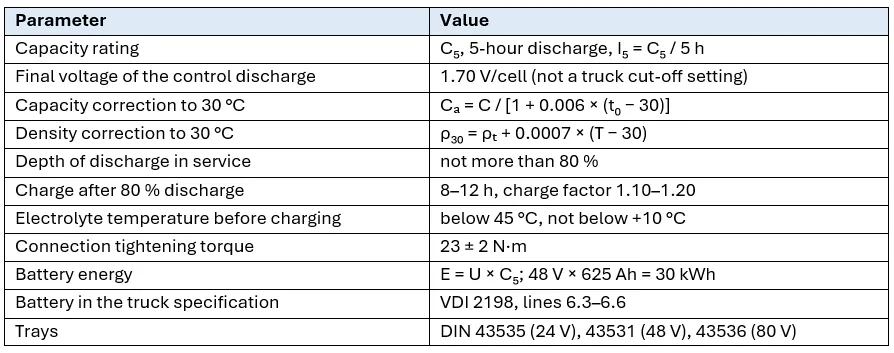
A well-chosen battery runs for years without surprises. A badly chosen one goes flat before the end of the shift and calls for a second set, or for charging infrastructure nobody planned for. The difference is decided before the purchase, by three questions: what the truck’s technical specification says, how much energy your shift takes and when it can be put back, and whether the test report confirms the rated capacity. This post shows how to answer each of them in a few minutes.
1. The Truck’s Technical Specification
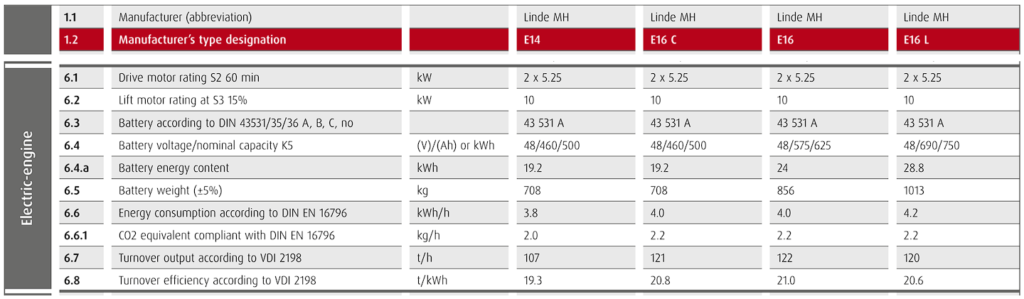
Figure 1 — Section 6 of the technical data for Linde E14 to E16 L trucks, VDI 2198 format. Lines 6.3–6.6 define the battery.
Each line is either a constraint or a hint for choosing the battery:
- 3 — tray standard: DIN 43531 A, i.e. a 48 V battery in a configuration A tray.
- 4 — voltage and nominal capacity K5. K5 is the same five-hour capacity our first post was about. For the E16: 48 V and 575 or 625 Ah.
- 4.a — battery energy: 24 kWh for the E16. That is exactly 48 V × 625 Ah × 0.8, so the truck manufacturer already counts only the energy available at 80 % depth of discharge.
- 5 — battery mass: 856 kg ±5 %. On a counterbalance truck the battery is also the counterweight, so this line is not just for reference: the battery cannot be replaced with a noticeably lighter one.
6.6 — energy consumption over the standard DIN EN 16796 cycle: 4.0 kWh per hour. This is the most underrated line on the sheet. It lets you work out, before buying, whether the battery will last the shift (section 2).
Tray standard and battery designation
Line 6.3 refers to three standards that differ only in voltage: DIN 43535 for 24 V (12 cells), DIN 43531 for 48 V (24 cells) and DIN 43536 for 80 V (40 cells). The letters A, B and C are different cell layouts inside the tray.
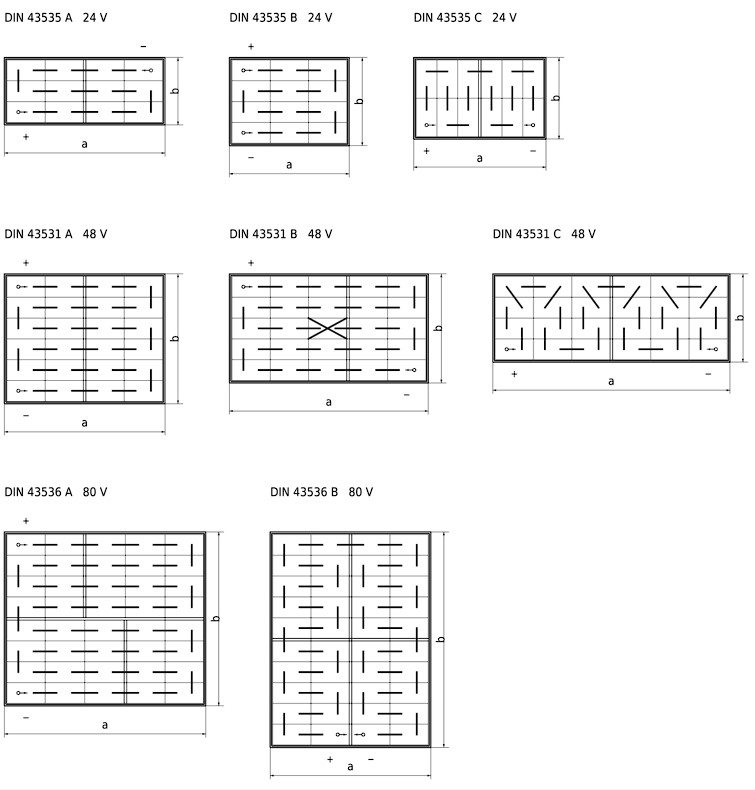
Figure 2 — Cell layouts in DIN 43535, 43531 and 43536 trays, configurations A, B and C.
A Black Horse battery is designated like this: BH 48V 4PzS 500Ah. Here 48V is the battery voltage, i.e. 24 cells of 2 V; 4 is the number of positive tubular plates in each cell; PzS is the cell type, with tubular positive plates and flooded electrolyte; 500Ah is the C5 capacity. The capacity adds up simply: the number of positive plates multiplied by the capacity of one plate. Plate capacity is set by plate height, and our range covers plates from 60 to 155 Ah. 4 × 125 Ah = 500 Ah.
This also explains the geometry. All Black Horse PzS cells have the same length, 198.5 mm, while the width grows with the number of positive plates, from 47.5 to 190.5 mm. In the same tray, capacity is therefore changed by choosing plate height and plate count, not by changing the case. And the designation becomes a check: if an offer says 5PzS 500, the numbers have to come out at 100 Ah per plate.
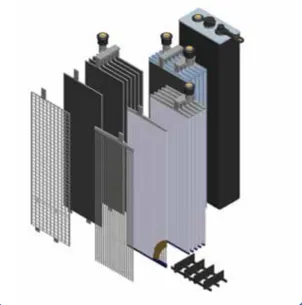
Figure 3 — Exploded view of a Black Horse PzS cell: tubular positive plates, separators, negative plates, container and lid with terminals.
The DIN standard covers most of the European fleet, but not all of it: Toyota has its own battery and tray specifications for each truck family, and reach trucks and stackers often use narrow, tall trays.
2. How Much Energy the Shift Takes
Ampere-hours are convenient for a catalogue, but a shift is easier to count in kilowatt-hours, the way the truck manufacturer does it. Battery energy is voltage multiplied by capacity: 48 V × 625 Ah = 30 kWh. The usable part at 80 % depth of discharge is 24 kWh.
The rest is simple arithmetic on real Linde E16 figures: 24 kWh ÷ 4.0 kWh/h = 6 hours of work at standard-cycle intensity. For an eight-hour shift with breaks, waiting and idle time, that is enough. For two shifts it is not: the second shift needs another 24 kWh.
Three corrections change the result:
- Your warehouse is not the standard cycle. Line 6.6 is there to compare trucks with each other. For the calculation, real data is better: an ampere-hour counter, the charger log, or a week of measurements.
- Available capacity drops by about 0.6 % for every degree below 30 °C. A warehouse at +15 °C takes about 9 %, and 6 hours of work become 5.5.
- Charging time. After an 80 % discharge a lead-acid battery needs 8–12 hours, plus time to cool down: charging starts at an electrolyte temperature below 45 °C. This is not a weakness of one particular battery but physics: a charge factor of 1.10–1.20 and a current that can be applied without overheating.
Hence the main conclusion of this section: the choice is decided not only by “how much” but also by “when”. How many hours a day the battery can stay on charge is as much a starting parameter as energy consumption.
3. Lead-Acid or Lithium: the Schedule Decides, Not the Trend
Lithium batteries have real advantages: they can be topped up during breaks, they need no watering and no battery change, and their charging efficiency is higher. But these are advantages of a particular operating mode. What matters far more is how many hours a day the truck works, how many shifts there are, and whether there is time during the day to put energy back into the battery.
A 24-hour view shows it best:
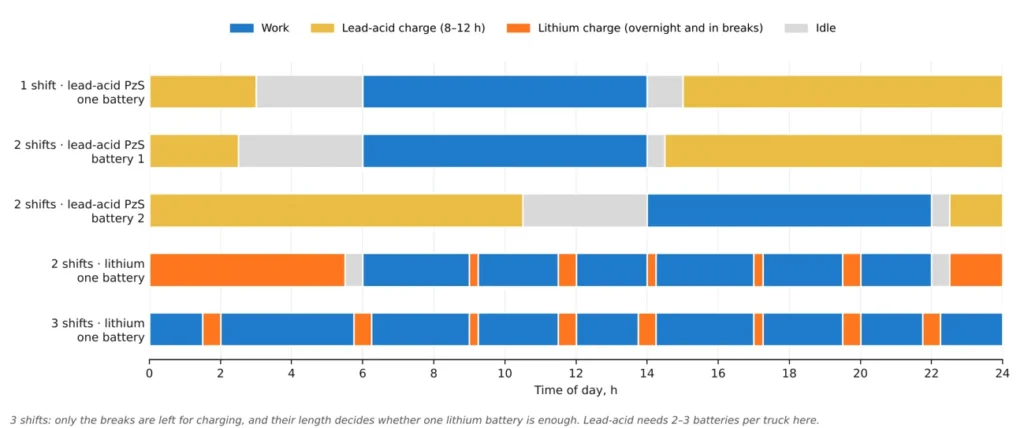
Figure 4 — A forklift’s 24 hours in different operating modes. The grey segments are pauses: the lead-acid battery cools down before charging (charging starts below 45 °C electrolyte temperature) or is already charged and waiting for its shift.
Black Horse calculation for a truck using 4 kWh/h with a 48 V battery.
When one lithium battery is not enough
Take the same Linde E16 working hard in two shifts, with 6 hours of effective work in each. Over a day that is 2 × 6 h × 4.0 kWh/h = 48 kWh.
The lead-acid option is two 48 V / 625 Ah batteries per truck. Each delivers 24 kWh; they are swapped between shifts, and while one works, the other charges and cools down for 8–12 hours. That gives 48 kWh a day, regardless of whether the driver gets any breaks.
The lithium option is one battery of the same size. In the morning it is fully charged. At the same 48 V / 625 Ah, about 30 kWh, its usable energy is around 27 kWh, because lithium is discharged to about 90 % rather than 80 % as with lead-acid. The missing 21 kWh has to be put back during the day:
E = 27 kWh + P × t × 0.95
where P is the charger power and t is the time the truck actually spent on charge during breaks.
Where the power figures come from. According to our operating instructions, a lead-acid battery is charged at 0.15·C5: for 625 Ah that is about 94 A at up to 2.4 V per cell, so 94 A × 57.6 V ≈ 5.4 kW, or about 6 kW from the grid allowing for charger efficiency. A lithium battery of the same size, about 30 kWh, is typically charged fully in about 2 hours, which means a current of about 0.5·C and a power of about 15 kW. Fast charging in about 1.2 hours takes about 25 kW.
At 15 kW the day is covered only if the breaks add up to at least 1.5 hours on charge. With two 30-minute lunch breaks you get 27 + 15 × 1 × 0.95 ≈ 41 kWh: about 7 kWh short, almost 1.7 hours of work at the end of the second shift. A 25 kW charger covers this day, but needs 1.7 times more power per truck.
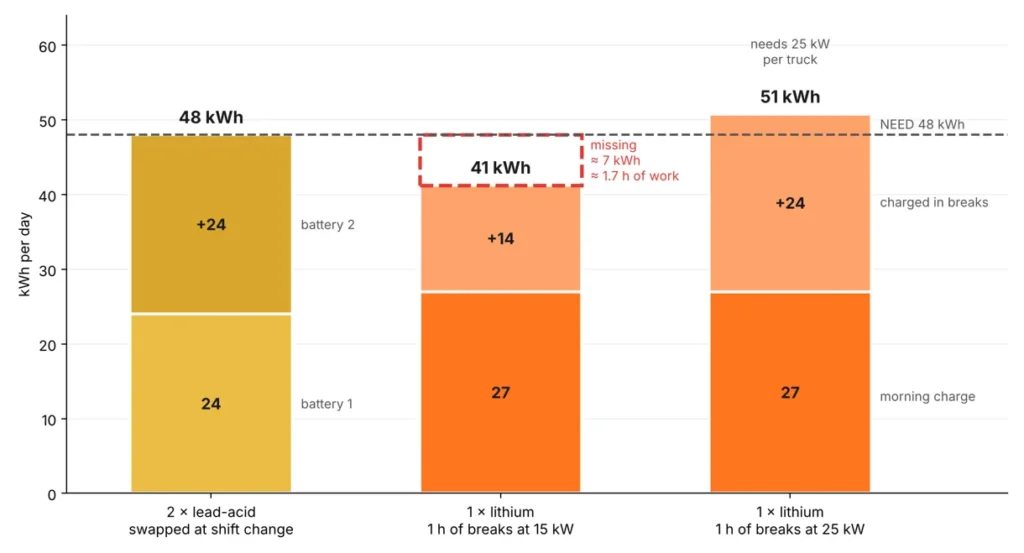
Figure 5 — Energy per day in two-shift operation: two lead-acid batteries versus one lithium battery topped up during breaks.
The harder the work, the wider the gap. On the same Linde sheet, the E20 has the same 48 V / 625 Ah battery, but line 6.6 already shows 4.5 kWh/h. A two-shift day needs 2 × 6 × 4.5 = 54 kWh. One lithium battery with an hour of 15 kW top-up charging still gives around 41 kWh: 13 kWh short, almost 3 hours of work. To cover the day, lithium needs almost 2 hours on charge during working time.
Lead-acid has a simple lever here: batteries can be swapped as often as needed. A third battery per truck, or a larger battery if line 6.4 allows it, covers the day without a single extra kilowatt of daytime power. Lithium has two levers, and both are expensive: more time on charge or more power, which in practice means a second lithium battery or another truck.
The conclusion: if breaks are short or irregular and the load is high, two or three lead-acid batteries deliver more energy per day than one lithium battery of the same size, and as a rule cost less.
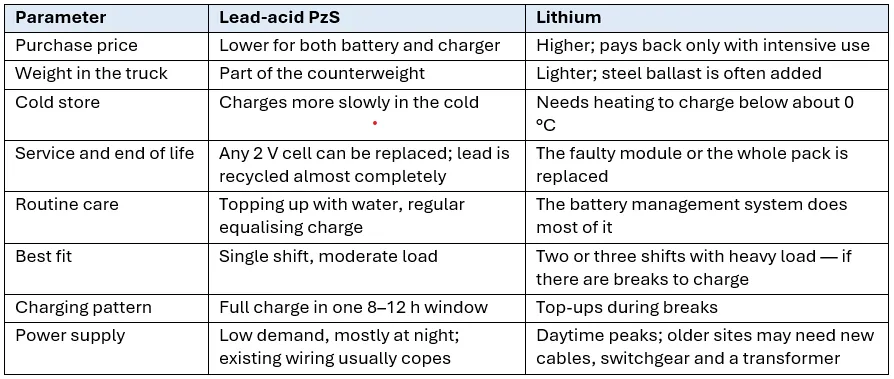
- A lithium battery is considerably more expensive, and the difference pays back only under intensive use. In a single shift, its cycle life simply never gets used.
Lead-acid and lithium: where each one is stronger
4. Battery Acceptance
A battery that is accepted and commissioned correctly will last its warranty period and deliver the rated capacity throughout. Mistakes in the first days — loose cell connections, topping up electrolyte, partial charges, an unsuitable charger — shorten that period. The acceptance procedure:
- Inspect the battery and the tray for damage, cracks, leaks, deformation, and damaged cables, connectors and inter-cell connections.
- Check the type, voltage, capacity, mass and polarity against the truck and charger data — the same lines 6.3–6.5.
- Check the tightening of terminal bolts and inter-cell connectors: 23 ± 2 N·m.
- Check the electrolyte level. If the plate bridges are not covered, add demineralised water only up to the minimum safe level, give a full charge and then bring the level to nominal.
- Install the battery without tilt and fix it securely; connect the plug with the truck and the charger switched off.
After the first full charge, record the voltage, electrolyte density and temperature of every cell. Density is compared only when corrected to 30 °C:
ρ₃₀ = ρₜ + 0.0007 × (T − 30)
A cell below 2.0 V after charging, or with noticeably lower density than the rest, is a reason to contact service.
Capacity of a new battery
IEC/EN 60254-1 allows a new traction battery to reach its rated capacity not immediately but over the first cycles. Black Horse batteries go through a C5 control discharge on the formation line and already deliver practically full rated capacity on the first cycle — 97.7 to 102.5 % in our tests.
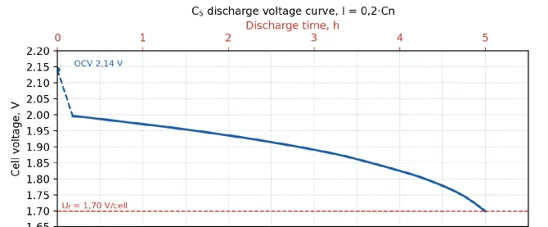
Figure 6 — C5 discharge curve of a Black Horse PzS cell (I = 0.2·Cₙ) to a final voltage of 1.70 V/cell.
How to check capacity correctly
Checking capacity means a test to IEC/EN 60254-1: a full charge, a constant-current discharge at I₅ = C₅/5 to 1.70 V per cell, and correction of the result to 30 °C based on the initial electrolyte temperature:
Cₐ = C / [1 + 0.006 × (t₀ − 30)]
For example, 640 Ah measured at 40 °C equals 604 Ah at 30 °C.
Every Black Horse battery comes with a technical passport, a declaration of conformity, operating instructions and a warranty card, and the battery log starts with the acceptance data.
Five Questions Before You Order
- What do lines 6.3–6.5 of your truck’s type sheet say: tray standard, voltage and K5 capacity, permitted mass?
- How many kilowatt-hours does the truck use per shift — according to line 6.6, or better, measured?
- How many hours a day can the battery stay on charge, and how many breaks are longer than 15 minutes?
- What is the temperature in the warehouse and in the charging area?
- Which documents come with the battery: test report, technical passport, declaration, instructions, warranty card?
Reference Values